QuickBooks Error 6000 – Complete Guide to Restore Company File Access
The company file in QuickBooks plays a vital role as it contains sensitive information about your business finances, and companies can’t afford to lose it. But sometimes users fail to access the company file due to the occurrence of QuickBooks Error 6000. It occurs due to file corruption, damaged network files, incorrect hosting setups, or restrictive folder permissions. This issue restricts access to the company file and may disrupt daily accounting operations until the underlying problem is resolved.
In this comprehensive guide, we will walk you through all the possible causes and proven methods to fix Error 6000 in QuickBooks Desktop and restore company file access.
What is QuickBooks Error 6000?
QuickBooks error 6000 is a company file error that occurs when QuickBooks cannot access or open a company file due to file corruption, network issues, damaged .ND and .TLG files, or insufficient folder permissions. This error may occur in both local and network setups. The error usually has 3 or 4 digits along with a message stating you can’t open your company file.
The following are the common error messages related to the 6000 series errors you may notice while opening the company file.
- An error occurred when QuickBooks tried to access the company file.
- QuickBooks cannot open the company file.
- Unable to access the company file due to file corruption or network issues.
- QuickBooks has encountered a problem opening the company file.
- The company file cannot be opened due to network or data issues.
- QuickBooks is unable to open this company file. Please try again.
- You don’t have permission to access this company file.
- The company file is already in use or cannot be opened.
List of Different QuickBooks 6000 Series Errors
The different QuickBooks 6000 series errors that may appear when opening company files are;
| 6176, 0 | 6000, 107 | 6000, 1076 |
| QuickBooks Error 6010, 100 | 6138, 105 | 6210, 0 |
| 6189, 83 | -6190, -83 | -6012, -1061 |
| -6144, -82 | -6000, -82 | -6129, -101 |
| -6190, 816 | -6190, -85 | -6190, -82 |
| -6000, -832 | -6144, -304 | -6190, 1005 |
| -6189, 1005 | -6000, -305 | -6073, -816 |
| -6144,-103 | -6144, 0 | -6120, 0 |
| -6087, 0 | 6131, 0 | -6147, 0 |
Common Causes Behind Error 6000 in QuickBooks
To fix Error 6000 in QuickBooks easily, let’s study all the major causes that trigger the error while opening the company file.
- Incorrect hosting settings.
- Damaged or corrupt configuration files i.e, .ND and .TLG.
- Using the corrupt or damaged company file.
- Not having enough QuickBooks folder permissions to read or write the files.
- If the Windows Firewall or antivirus software has blocked access to QuickBooks processes or network ports used to open files.
- Problems with the company file location or path.
- Damaged or incomplete installation of QuickBooks Desktop.
- Unstable or weak network connectivity between the server and workstations.
How to Fix QuickBooks Desktop Error 6000 Instantly?
Perform the following troubleshooting methods to resolve QuickBooks Desktop Error 6000.
Method 1: Update QuickBooks
Here are the steps to download the latest QuickBooks updates.
- Exit from your company files and QuickBooks.
- Click the Start menu, look for QuickBooks, and right-click on the icon. Then, select the Run as Administrator option.
- Navigate to the Help menu and choose Update QuickBooks Desktop.
- Move to the Options tab, hit the Mark All and then Save option.
- Select the Update Now tab and tick the checkbox for Reset Update.
- When the process is complete, choose Get Updates.
Method 2: Run QuickBooks File Doctor Tool
The QuickBooks File Doctor tool is used to repair the data corruption and network connectivity issues that are causing the 6000 series errors. It resolves these issues by automatically scanning your company files, resetting the hosting configuration, and repairing damaged file paths.
Method 3: Rename the .ND and .TLG Files & Run the Database Server Manager
The .ND (Network Data) and .TLG (Transaction Log) files help QuickBooks access and manage company files in a network environment. If these files become damaged or corrupted, QuickBooks may fail to open the company file and display the 6000 Error QuickBooks. Renaming the files allows QuickBooks to automatically create fresh copies, which can help restore access and resolve the error. QuickBooks creates these files once again when you scan with QuickBooks Database Server Manager and while accessing your company file.
Step 1: Rename the .ND and .TLG Files
- Navigate to the folder where your QuickBooks company file is stored.
- Locate the files that have the same name as your company file but end with the .ND and .TLG extensions.
- company_file.qbw.nd
- company_file.qbw.tlg
- Right-click each file and select Rename.
- Add .OLD to the end of the file name.
- Example: company_file.qbw.nd.OLD
- Example: company_file.qbw.tlg.OLD
- Press Enter to save the changes.
- Reopen QuickBooks and check if the error has been resolved.
Step 2: Run the QuickBooks Database Server Manager from the QuickBooks Tool Hub
The QuickBooks Database Server Manager is used to host your company files. You need to restart the QBDBSM and then scan the QuickBooks files after renaming the .ND and .TLG files.
- Download and install the QuickBooks Tool Hub to run the QuickBooks database server manager.
- Open the Tool Hub and then click Network Issues.
- Navigate to QuickBooks Database Server Manager. Make sure to install QuickBooks on your server if you haven’t installed it already.
- In QuickBooks Database Server Manager, click Start Scan if your company file appears in the list.
- If the file is not listed, click Browse, navigate to the folder containing your company file, and then select Start Scan.
- Once the scan is complete, reopen QuickBooks and try accessing your company file. If the error persists, proceed to the next method.
Method 4: Open a sample company file
Opening a sample company file can help identify the cause of QuickBooks Company File Error 6000. If the sample file doesn’t open and shows the same error, the issue is likely with your QuickBooks installation. Repairing QuickBooks Desktop can fix damaged program files and help resolve the error.
- Choose the Open a Sample File option in the No Company Open window.
- Now, pick any file from the list of sample company files.
- If you get an error message while opening the sample file, you need to repair your QuickBooks installation files.
Method 5: Copy the QuickBooks file to the Desktop
Moving the company file to your desktop helps determine whether the issue is related to the file’s location.
- If the file opens successfully on the desktop, the location where you save your company file is damaged.
- Your file is available in too many folders and crosses the file system path limitation.
- However, if the file still won’t open after being moved, the company file itself may be damaged.
- Navigate to the folder containing your company file.
- After that, look for the file having .QBW extension.
- Right-click on the file and click Copy. Move to the desktop, right-click anywhere on the desktop and choose Paste.
- Press and hold the Ctrl key and open QuickBooks to bring up the No Company Open window.
- Select Open or Restore an Existing Company, then navigate to your desktop and open your company file.
- If the error persists, proceed to the next solution.
If your issue is still not resolved, then follow the troubleshooting methods depending on whether you are working on a desktop or over a server.
Case 1: If you open the file locally
This issue mainly arises when you open your company file on the same computer where you installed QuickBooks.
Method 6: Restore a backup
Restoring the backup company file helps determine whether the problem is with the current company file (.QBW).
If you encounter an error while restoring a backup, perform these steps;
- Verify that your computer isn’t hosting.
- Launch your company file and move to File > Utilities.
- If you notice that the Stop Hosting Multi-User Access is listed;
- Pick Stop Hosting Multi-User Access.
- Click Yes in Stop hosting multi-user access.
- Hit the Yes option in the Company file must be closed window.
- Now, verify that the company file path isn’t longer than 210 characters.
- Move to your QuickBooks company file location.
- Copy the path from the address bar.
- Next, paste the path into the notepad and count the characters and the spaces. For example: C:Documents and SettingsAll UsersDocumentsIntuitQuickBooksSample Company FilesQuickBooks 2018Sample_company_file.qbw is 125 characters.
- Afterwards, try to restore your company file again.
- If the error persists, move on to the next solution.
Method 7: Use Auto Data Recovery to restore your backup
If the QuickBooks company file is damaged, recover your lost data with QuickBooks data recovery.
Recover recent transactions using the original .TLG file with .QBW.adr file.
- Generate a new folder on your desktop named QBTest.
- After this, open the QuickBooks company file folder.
- Tip: You can check your company file location on the Product Information screen (press the F2 or Ctrl + 1 on your keyboard) and No Company Open window.
- Search for the .tlg file in your company file folder. It has exactly the similar name as your company file. If you can’t identify .tlg file, use these steps to show file extensions.
- Launch File Explorer by hitting the Windows + E keys.
- Click Organize and select Folder and search options.
- Choose Hide extensions for known file types.
- Hit the Apply and then OK option.
- Copy the corresponding .tlg file of your company file, and then paste it into the QBTest folder on your desktop.

- Now, open the QuickBooksAutoDataRecovery folder. You will find the same location as your company file.
- Copy the .QBW,adr file and paste it into the QBTest folder. You will see both the .QBW.adr and .tlg file in your QBTest folder.

- Right-click the .QBW.adr file in your QBTest folder and click Rename.
- Delete the .adr file extension at the end of the file.

- Launch QuickBooks and open the company file placed on your QBTest folder.
- Choose File > Utilities > Verify Data to check the data integrity of the recovered file.
- If the copy of your company file is good, move the damaged company file to a different location. Then, transfer the copy from QBTest to the original location.
Case 2: If you open the file over a network
Method 8: Check if Hosting is on for all workstations
Make sure to use one computer or server to host the company files.
- Hit F2 to open the Product Information page.
- Look for the Local Server Information. Ensure that the hosting is turned off.
Method 9: Close all QuickBooks processes
- First, log in as the Administrator on your server computer.
- PressCtrl + Shift + Esc to bring up the Task Manager.
- Now, show processes for all users and click Users.
- Choose each QuickBooks process (QBW32.EXE, qbupdate.exe, and QBDBMgr.exe), and tap on End Task.
- Finally, try to open the company file in multi-user mode.
Method 10: Check the folder permissions manually
You may receive Company file error code 6000 in QuickBooks when your company file folder doesn’t have proper permissions. Review your folder permissions manually to share your company files.
- Go to the Start menu and launch the File Explorer.
- Right-click on your company file folder and choose Properties.
- Hit the Advanced menu on the Security tab.
- Select QBDaraServiceUserXX and opt for the Edit menu.
- Configure the following settings to Allowed;
- Traverse Folder/Execute File
- List Folder/Read Data
- Read Attributes
- Read Extended Attributes
- Create Files/Write Data
- Create Folders/Append Data
- Write Attributes
- Write Extended Attributes
- Read Permissions
If the permissions aren’t set incorrectly;
- Click the Start menu and open File Explorer.
- Right-click on the the following folders listed below.
| C:\Program Data\Intuit\Entitlement Client\v8 |
| C:\Program Data\Intuit\Entitlement Client\v6.0 |
| C:\Program Data\Intuit\Entitlement Client\v5 |
| C:\Program Data\Intuit\Entitlement Client\v3 |
| C:\Program Data\Intuit\Entitlement Client |
| C:\Program Data\Intuit\QuickBooks Enterprise Solutions X.0 (X = version) or C:\Program Data\Intuit\QuickBooks 20XX (XX = year) |
| C:\Program Data\COMMON FILES\INTUIT |
| C:\Program Data\COMMON FILES\INTUIT\QUICKBOOKS |
| C:\Users\Public\Public Documents\Intuit\QuickBooks\FAMXX (XX = year) |
| C:\Users\Public\Public Documents\Intuit\QuickBooks\Company Files |
| C:\Users\Public\Public Documents\Intuit\QuickBooks\Sample Company Files\QuickBooks Enterprise Solutions X.0 (X = version) or C:\Users\Public\Public Documents\Intuit\QuickBooks\Sample Company Files\QuickBooks 20XX (XX = year) |
Change Folder Permissions
- Right-click on company file folder and click Properties.
- Click Everyone when on the Security tab.
- Choose Full Control, then hit the Apply and OK options.
Method 11: Configure Firewall Ports & Antivirus Software
You may encounter Error Code 6000 in QuickBooks Desktop, due to the blockage of firewall and antivirus program accessing certain QuickBooks file or folders. So, it’s a must to set the firewall ports and set up an exception in your antivirus software.
- Click the Start menu and type Windows Firewall in the search box.
- Open Windows Firewall and click Advanced Settings.
- Now, right-click Inbound Rules and create Outbound Rules. Then, click New Rule.
- Tap on Port and hit Next.
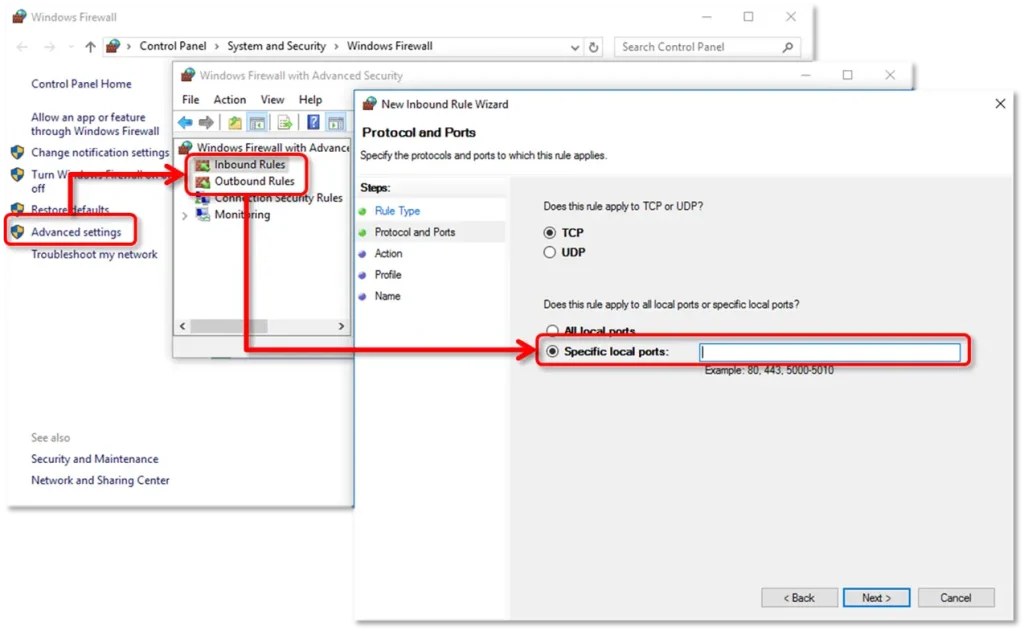
- Tick the TCP checkbox.
- Type the specific ports required according to your QuickBooks year version.
- QuickBooks Desktop 2020 and later: 8019, XXXXX.
- QuickBooks Desktop 2019: 8019, XXXXX.
- QuickBooks Desktop 2018: 8019, 56728, 55378-55382.
- QuickBooks Desktop 2017: 8019, 56727, 55373-55377.
- Click Next after mentioning the port number.
- Navigate to Allow the Connection > Next.
- If prompted, ensure that all profiles are marked and select Next.
- Create a new rule and rename it “QBPorts(year)”.
- Hit the Finish option after completing the process.
Use the above steps to create an outbound rule. Perform all the same steps, except click Outbound Rules on step 4.
Final Thoughts
Encountering QuickBooks Error 6000 might be frustrating, especially when users can’t access their company file. You may encounter different error codes such as QuickBooks error 6000 77, QuickBooks error 6000 1074, QuickBooks error code 6000 80, or QuickBooks error code 6000 308 due to data damage, incorrect folder permissions, or hosting settings, or blockage of third-party security software. But by performing the above solutions, you can easily fix the company file errors.
To minimize the risk of future company file errors, keep QuickBooks updated, maintain regular backups, and ensure proper network configuration.
Frequently Asked Questions
What are the symptoms of QuickBooks 6000 series error codes?
When this error occurs, you may notice the following symptoms:
- Failure to access the company file
- An error message appears while opening or restoring the company file
- Unable to use multi-user mode
- The application freezes or starts running slowly.
Why does QuickBooks Error 6000 occur when opening a company file?
This error mainly occurs when opening the company file due to data corruption, incorrect file location or path, restricted permissions, and network issues.
What happens if .ND and .TLG files are corrupted in QuickBooks?
.ND and .TLG files gets corrupted, QuickBooks fails to open the company file in multi-user mode and started flashing Error 6000 QuickBooks.
Can long file paths cause QuickBooks Error Code 6000?
Yes, if the company file path exceeds its limitations, QuickBooks fails to open the company file and starts showing Error 6000.
How can I prevent QuickBooks Error 6000 in the future?
To prevent this error, regularly update QuickBooks, maintain proper folder permissions, ensure stable network connectivity, and create frequent backups.

Recent Posts
QuickBooks Payroll: Service, Setup, Pricing and Support Guide
Read MoreQuickBooks Error Support: Get Instant Help Via Live Chat or Call
Read MoreQuickBooks Error 3371 Explained: Common Causes and 7 Effective Fixes
Read MoreHow to Contact QuickBooks Customer Service and Talk to a Live Expert
Read MoreHow to Update QuickBooks Company File Without Losing Data?
Read More